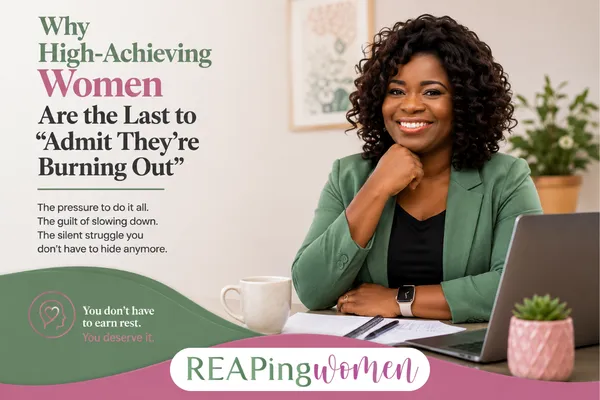
Why High-Achieving Women Are the Last to Admit They're Burning Out
By Dr Catherine Muyeba | Consultant Psychiatrist | Lifestyle Physician
She is the one everyone calls dependable. The one who delivers. The one who shows up for her team, her clients, her family, her friends, even when she has nothing left to give. She is high-achieving, highly capable, and quietly falling apart.
She is not weak. She is not lazy. She is burnt out. And she is the last to admit it.
If this sounds familiar, you are not alone. What you are experiencing has a name, a science, and, crucially, a way through.
The Silent Epidemic Nobody Talks About
Burnout does not announce itself loudly. It does not arrive one morning with a formal letter of resignation from your nervous system. It creeps in slowly, disguised as tiredness you cannot shake, irritability you cannot explain, and a growing sense that no matter how much you do, it is never quite enough.
For high-achieving professional women, this creeping burnout is particularly dangerous because the very traits that make you successful make you less likely to recognise it and less likely to ask for help.
The evidence is increasingly clear. According to the Women in the Workplace 2025 report, one of the largest studies of women in corporate America, conducted by McKinsey & Company and LeanIn.org, surveying over 3 million employees across 124 companies, approximately 60% of senior women reported frequently experiencing feelings of burnout, compared to 50% of senior men. For women newer to senior roles, the figures were even starker: 70% of senior women with fewer than five years in their current organisation reported frequent burnout.
This is not a personal failing. It is a systemic pattern. And it is playing out in consulting rooms, boardrooms, hospitals, law firms, and living rooms across the country every single day.
Why High-Achieving Women Are the Last to Know
Here is the paradox that I see again and again in my clinical practice: the women who are most at risk of burnout are precisely the women who are least likely to recognise it by themselves or by anyone else.
Why? Because they are still performing.
They are still hitting targets. Still responding to emails at 11pm. Still presenting at meetings with precision and polish. Still being the person everyone leans on. From the outside, everything looks fine. From the inside, the lights are slowly going out.
There are several reasons high-achieving women miss their own burnout signals:
They have normalised exhaustion. When you have been running on adrenaline and ambition for years, fatigue starts to feel like your baseline. You stop recognising it as a warning sign and start accepting it as the price of success.
They compare themselves upward. High achievers rarely measure themselves against what is average. They measure themselves against the most productive person in the room and convince themselves they should be able to do more, not less.
They confuse busyness with worth. In a culture that rewards output and penalises stillness, many high-achieving women have unconsciously tied their identity to their productivity. Resting feels dangerous. Slowing down feels like falling behind. Asking for help feels like admitting defeat.
They are carrying an invisible load. Despite their own increasing burnout, women often take more consistent action to support colleagues and direct reports than men in similar leadership positions. Women leaders are simultaneously managing their own depletion whilst propping up everyone else’s wellbeing. It is an unsustainable equation.
They mistake the symptoms for something else. Difficulty concentrating gets blamed on a busy season. Sleep problems are put down to stress. Emotional flatness is dismissed as just needing a holiday. By the time the pattern is clear, burnout is already deeply embedded.
What Burnout Actually Is. And What It Is Not
Let me be clinically precise here, because this matters.
Burnout is not the same as stress. Stress, in the short term, is a normal and even useful physiological response. It sharpens your focus, motivates action, and helps you perform under pressure. The problem begins when that stress becomes chronic when the demands placed on you consistently outstrip the resources you have to meet them, and your system never gets the chance to recover.
The World Health Organisation formally classifies burnout as an occupational phenomenon rather than a medical diagnosis, characterised by three dimensions: emotional exhaustion, depersonalisation (a sense of mental distance and cynicism about your work), and reduced personal accomplishment, that hollow feeling that what you do no longer matters, or that you are no longer capable of doing it well.
What burnout is not is a character flaw. It is not weakness. It is not ingratitude for the opportunities you have worked so hard to create. It is a clinical response to prolonged, unmanaged stress and it is entirely preventable when you know what to look for and what to do about it.
Three Actionable Steps You Can Take Right Now
You do not need to wait until you hit the wall to change direction. Here are three evidence-based steps you can begin today:
1. Name Your Stress Before It Names You
The single most powerful thing you can do is develop what clinicians call stress awareness. The ability to notice your own early warning signals before they escalate. Most high-achieving women only register stress when it becomes undeniable: a panic attack, a health scare, an emotional collapse. By that point, you are already in crisis management rather than prevention.
This week, try this: Set a daily alarm for 5pm and ask yourself three questions:
- How is my energy today and why?
- What drained me most today?
- What, if anything, restored me?
You are not solving anything yet. You are simply building the habit of noticing, and noticing is where all change begins.
2. Audit Your Recovery — Not Just Your Output
High achievers are brilliant at tracking what they produce. They are far less skilled at tracking whether they are recovering from producing it. Recovery is not a reward for completing your to-do list. It is a clinical necessity, as essential to your performance as the work itself.
This week, try this: For the next seven days, track your sleep, your movement, your meals, and one moment of genuine connection or stillness each day. You do not need an app or a system. A simple notebook will do. What you are looking for is the gap between what your body needs to function optimally and what it is actually getting. That gap is where burnout lives.
3. Say No to One Thing — and Mean It
Burnout thrives in the absence of boundaries. For high-achieving women, boundaries are often the last self-care tool deployed because saying no feels risky, selfish, or at odds with the identity of someone who gets things done. But every yes to something that depletes you is a no to something that sustains you.
This week, try this: Identify one commitment, request, or obligation that you are currently carrying out of obligation, guilt, or habit, not genuine alignment with your values or goals. Then decline it, delegate it, or defer it.
Notice what happens in your body when you do. That sensation of relief mixed with anxiety? That is the edge of a new, more sustainable way of living. Step over it.
You Were Not Made to Simply Endure
The women I have the privilege of working with, brilliant, driven, accomplished women, are not burning out because they are not strong enough. They are burning out because they have been strong for too long, without adequate rest, support, or permission to be human.
The REAP & RISE framework was built for this exact moment in a woman’s life. Not when everything has fallen apart but when she is beginning to sense that something needs to change before it does.
Rest is not the absence of ambition. It is the foundation of it.
If you recognise yourself in this article, I want you to know: there is a path through, and you do not have to walk it alone.
→ Download your free REAP & RISE Roadmap Workbook and begin setting the foundation for your next 90 days.
→ Join the REAP & RISE community, a free space for high-achieving women who are done surviving and ready to thrive.
Dr. Catherine Muyeba is a Consultant Psychiatrist, ADHD Specialist, certified Lifestyle Physician, Amazon bestselling author, and founder of the REAP & RISE movement. She has over 25 years of clinical experience supporting high-achieving professional women to live vibrant, sustainable, and fulfilling lives.
Reference
McKinsey & LeanIn.org — Women in the Workplace 2025
